
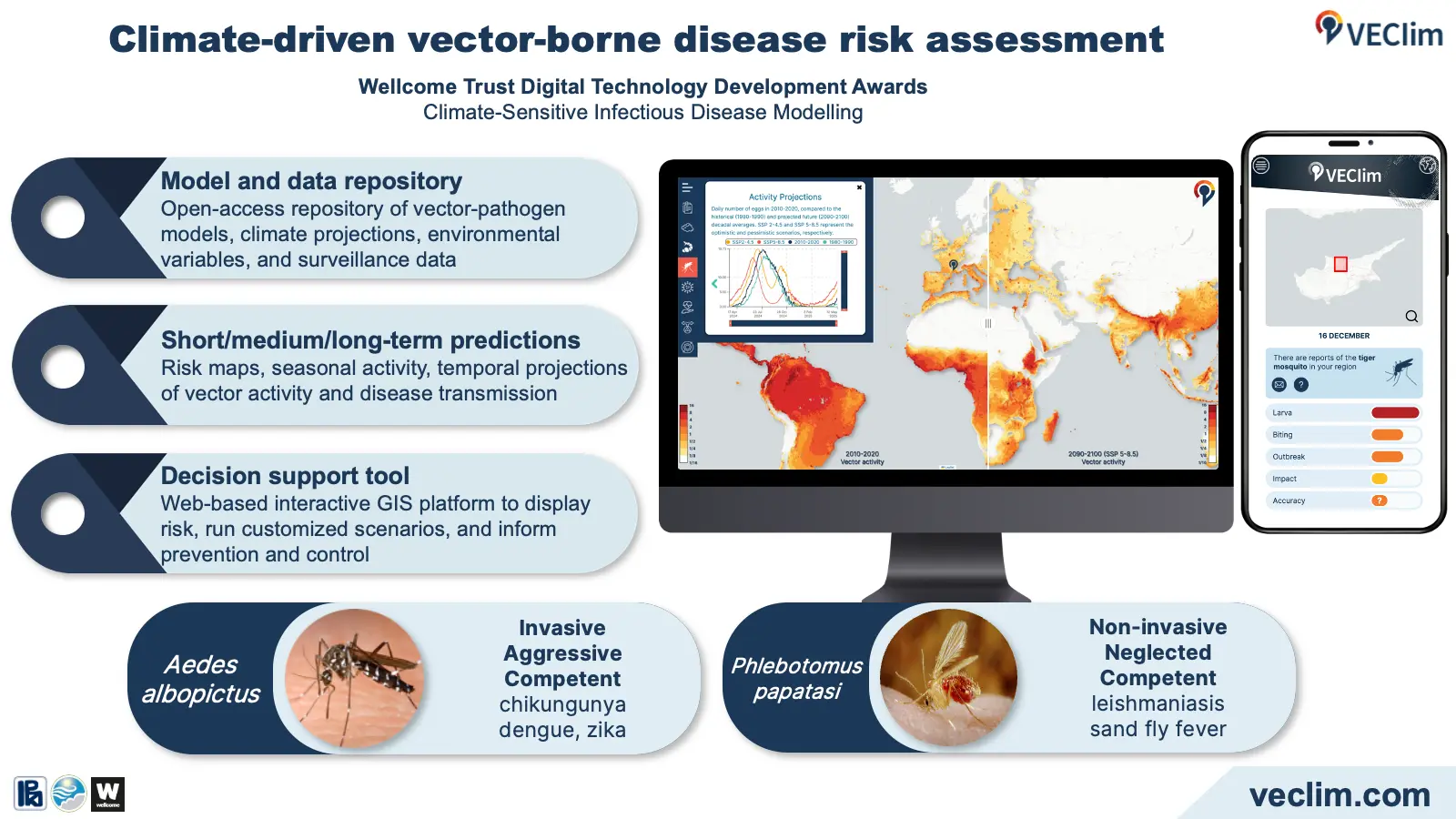
Climate change and human activities introduce growing uncertainty into our understanding of the dynamics and geographic distribution of disease vectors and the pathogens they transmit, including malaria, dengue fever, and yellow fever. Capturing these complex and evolving environmental dependencies requires accurate mathematical representations and advanced computational approaches.
The Climate and Vector-Borne Diseases group aims to support the planning of effective management strategies to minimise the health impacts of future outbreaks by developing predictive, reliable, and widely applicable models of vectors and pathogens.
-
VEClim is funded by the Wellcome Trust (UK) through the Digital Technology Development Awards (Climate-Sensitive Infectious Disease Modelling). It is the first award of this kind that the Wellcome Trust has made directly to a Cypriot institution.
Through VEClim, we have developed a powerful digital engine capable of running periodic and on-demand numerical simulations to predict the abundance and activity of key disease vectors, as well as the risk of vector-borne diseases, at any location and time, extending to the end of the century.
VEClim's predictions are delivered through a user-friendly, interactive, web-based geographic information and decision support platform, fully integrated with the high-performance supercomputing infrastructure of The Cyprus Institute.